Real Estate
Buying a Riad in Marrakech as a Foreigner: Complete Legal Guide (2026)
An authoritative, statute-grounded manual covering title due diligence, Melkia risk mitigation, notary vs. lawyer duties, Office des Changes repatriation guarantees, and exact closing taxes in Marrakech.
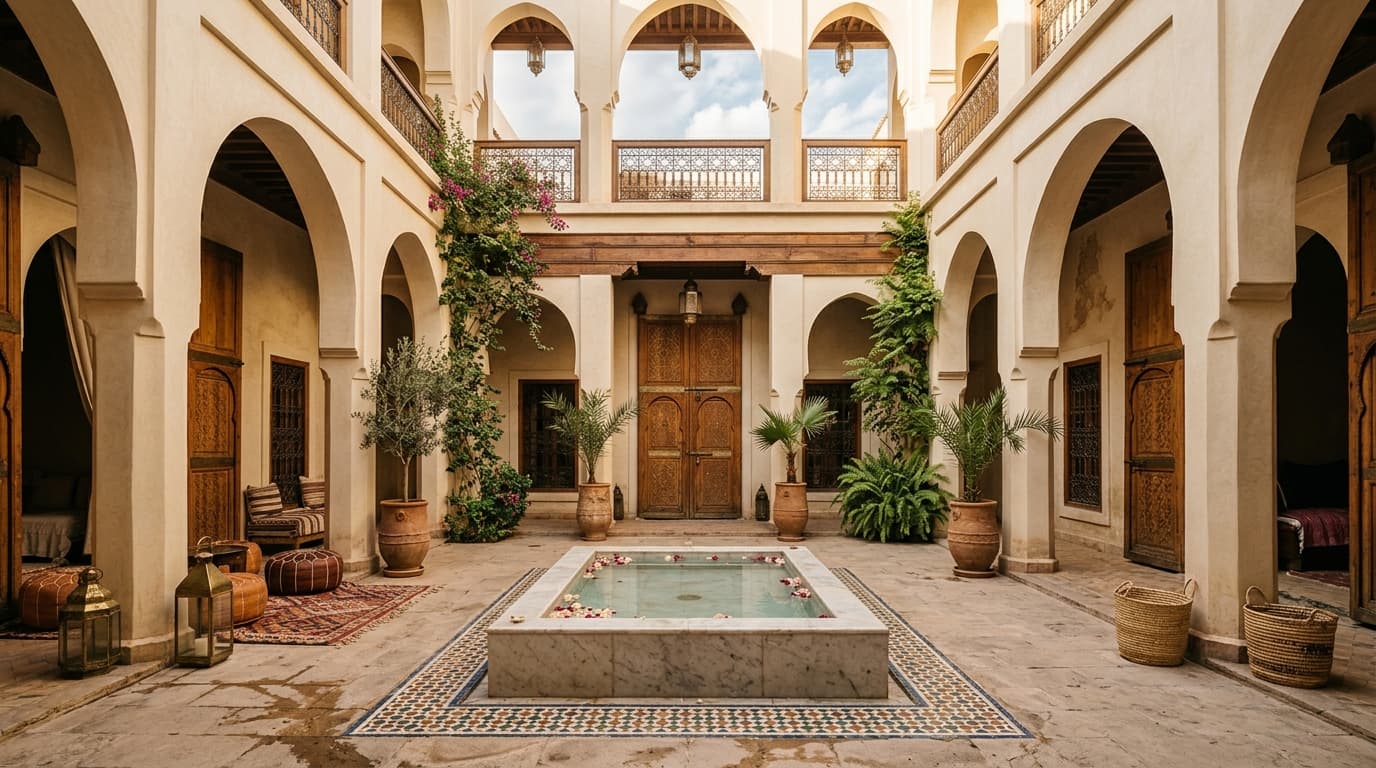
Acquiring a historic Riad inside the walls of Marrakech’s Medina—or a tranquil courtyard residence in Kasbah, Rmila, or Palmeraie—remains one of the Mediterranean and North African region’s most distinctive real estate investments. Yet the charm of carved cedarwood and lime tadelakt conceals a highly formal civil law system where a single overlooked document can lock capital for years.
This legal guide, prepared from daily property practice at our Marrakech chambers, walks foreign buyers through the exact statutory rules, registry verifications, and exchange-control mechanics required to acquire a Riad cleanly and preserve full resale and repatriation rights.
1. Titre Foncier vs. Melkia vs. Réquisition d’Immatriculation
Before negotiating price or paying a single dirham of deposit, establish the exact legal status of the Riad’s title. In Marrakech’s historic Medina, properties fall into three distinct legal categories:
| Title Status | Registry Authority | Legal Security | Foreign Buyer Guidance |
|---|---|---|---|
| Titre Foncier (TF) | Conservation Foncière (ANCFCC) | Definitive & state-guaranteed | Gold standard. Boundaries, exact square meters, mortgages, and owners are conclusively verified. |
| Réquisition d’Immatriculation | Pending at ANCFCC | Intermediate (in conversion) | Title conversion is underway. Must audit for third-party oppositions (Oppositions) before signing. |
| Melkia (Adoul Deed) | Traditional Adoul Registry | Unregistered / High Risk | Requires exhaustive chain-of-title audit, heir sign-off verification, and strict contractual protections. |
Why Melkia Riads Require Specialized Counsel
Many authentic 18th- and 19th-century Riads in Marrakech Medina remain held under Melkia deeds. While purchasing a Melkia property is legally permitted, traditional deeds frequently omit exact surveyed surface areas, list deceased co-heirs (Indivision successorale), or mask historical encroachments on neighboring patios or alleyways (Derbs).
If you wish to acquire a Melkia Riad, your preliminary contract (Compromis de Vente) should strictly condition closing—or escrow a substantial portion of the purchase price—on the filing of a formal Réquisition d’Immatriculation, a sworn land surveyor’s boundary plan (Plan topographique), and verification that no family co-heirs hold unwaived preemption rights (Chafaa).
2. Independent Lawyer vs. Moroccan Notary: Understanding the Divide
A frequent misconception among UK, European, and North American buyers is assuming that the Moroccan notary (Notaire) acts as their personal legal representative.
- The Moroccan Notary is an impartial public officer appointed by the State. The notary drafts the final transfer deed (Acte Authentique), holds funds in a regulated Caisse de Dépôt et de Gestion (CDG) escrow account, collects registration taxes, and submits the transfer to the Land Registry. Because the notary must remain neutral between buyer and seller, they cannot aggressively negotiate one-sided protective clauses for you or represent you in court if a dispute erupts.
- Your Independent Marrakech Attorney owes an exclusive fiduciary duty to you alone. As an attorney accredited before the Cour de Cassation, Maître Kabba Hamid audits the seller’s title and municipal compliance independently, redlines the Compromis de Vente before you sign, verifies hidden civil or inheritance litigation, and stands ready to litigate if the seller breaches.
3. Step-by-Step Riad Acquisition Timeline
Six Legal Stages to Closing a Marrakech Riad
- 01
Pre-Offer Legal & Title Audit
3–5 Business DaysPulling a same-day Certificat de Propriété from the Conservation Foncière, checking mortgages, seizures, urban zoning, and seller identity/matrimonial capacity.
- 02
Opening a Convertible Dirham Account
3–7 Business DaysOpening a non-resident bank account in Marrakech to receive wired foreign currency and generate the official Office des Changes repatriation trail.
- 03
Protective Compromis de Vente
Week 2Executing a lawyer-reviewed preliminary sales agreement with explicit conditions precedent (clean title, municipal tax clearance, empty possession, and VNA/licensing if applicable). Deposit (typically 10%) held strictly in notary CDG escrow.
- 04
Tax Clearance & Municipal Verification
Weeks 3–6Seller obtains municipal tax clearance (Quitus fiscal) confirming all urban property taxes (Taxe d’habitation and Taxe de services communaux) are settled, alongside Habitation Certificate or guest-house classification checks.
- 05
Final Acte Authentique & Fund Settlement
Weeks 6–10Wiring the balance through Office des Changes channels into notary escrow, signing the final deed in person or via apostilled Power of Attorney, and receiving the keys.
- 06
Land Registry Transfer & Formule 2 Archive
2–4 Weeks Post-ClosingNotary registers your ownership at the Conservation Foncière and delivers your updated Certificat de Propriété alongside your permanent Office des Changes repatriation dossier.
4. Office des Changes & Protecting Capital Repatriation
Morocco enforces foreign exchange controls administered by the Office des Changes. For foreign buyers, compliance is straightforward—but unforgiving if skipped:
- Wire Funds in Convertible Currency: Send all deposit and closing payments directly from your foreign bank account in EUR, GBP, USD, or CHF into your Moroccan convertible dirham account or directly into the notary’s bank account referencing the property purchase.
- Collect Your Currency Certificates (Formule 2 / Avis de Crédit): Your Moroccan bank must issue formal foreign currency transfer certificates proving the funds originated outside Morocco.
- Preserve the Complete File: When you eventually sell the Riad (or distribute rental profits from a licensed guest house), presenting the registered deed, tax clearance (TPI), and original currency certificates guarantees your statutory right to convert dirhams back into foreign currency and repatriate both your initial investment and net capital gains.
5. Operating a Riad as a Boutique Guest House (Maison d’Hôtes)
If you intend to rent your Riad commercially to tourists in Marrakech, residential ownership alone is insufficient. Commercial hospitality operation requires:
- Urban Compliance & Classification: Obtaining a Permis d’Habiter or Certificat de Conformité, safety clearance from Civil Protection (Protection Civile), and tourist classification authorization (Classement Maison d’Hôtes) from the regional Wilaya commission.
- Corporate Vehicle: Many investors hold the real estate personally while leasing it to a dedicated Moroccan SARL operating company, separating property equity from hospitality payroll and commercial liabilities.